

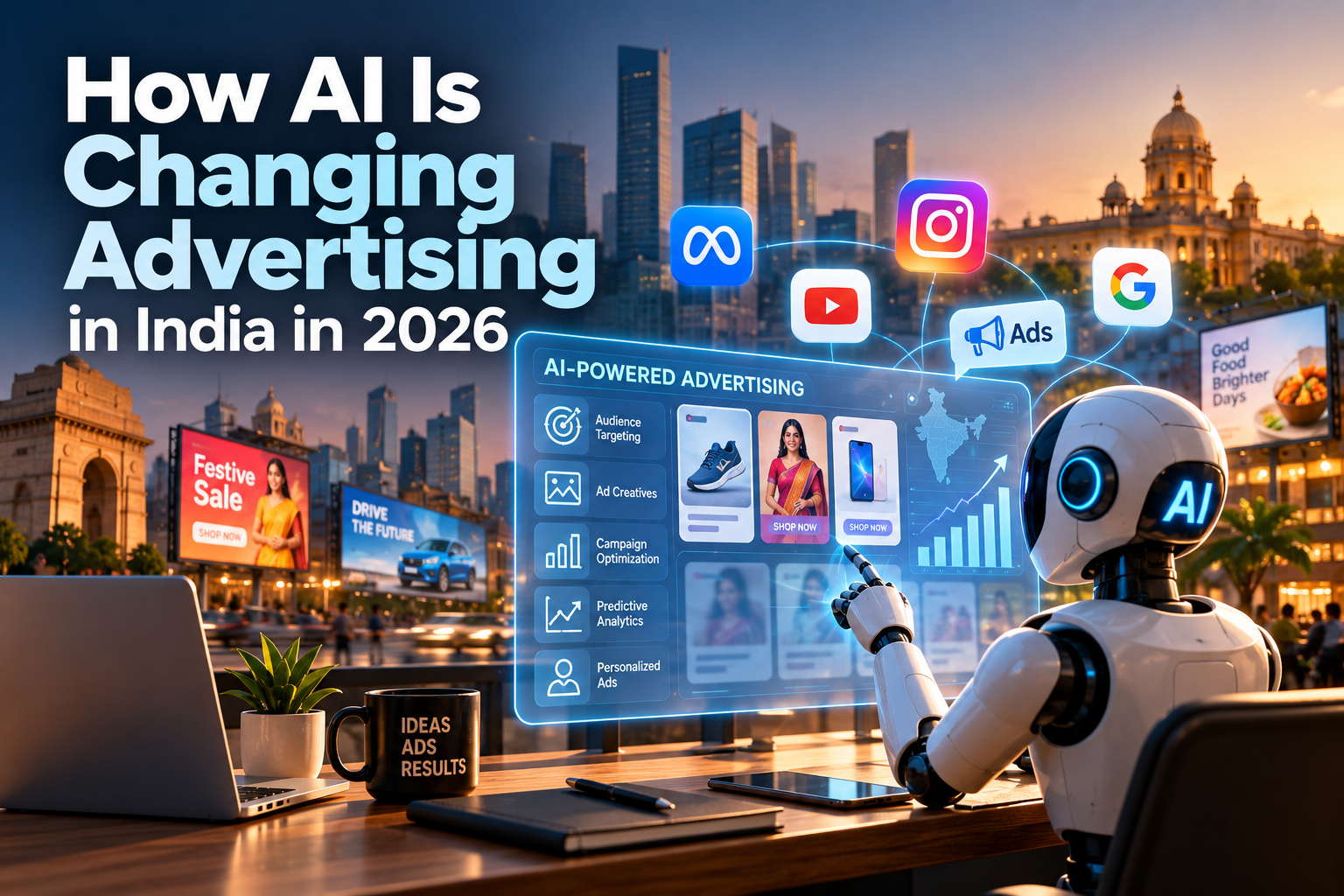
AI is changing advertising in India in three big ways in 2026. Ad platforms now decide most of the targeting and bidding themselves, creative work that took days now takes hours, and customers increasingly find brands through AI answers instead of a list of links. At the same time, India now has rules requiring realistic AI-generated images, video and voice to be labelled. Brands that do well will be the ones that use AI for speed and scale, and keep human judgement for strategy, local insight and trust.
Here is what the market looks like, the seven biggest changes, the new rules advertisers need to know, and what businesses should actually do about it.
India's advertising market in numbers
Metric | Figure |
Total Indian ad market, 2025 | ₹1,21,339 crore |
Digital ad spend, 2025 | ₹71,621 crore (59% of total, up 19%) |
Digital share projected for 2027 | About 70% |
Social media share of digital spend | 29% (₹21,057 crore) |
Online video share of digital spend | 28% (₹20,004 crore) |
Programmatic (automated) share of digital spend | 42% (₹30,081 crore) |
Print share of total ad spend | 14% (₹16,594 crore) |
Source: dentsu-e4m Digital Advertising Report 2026.
The line to notice is programmatic. Well over a third of Indian digital ad money is already bought and placed by software rather than by people negotiating with publishers. AI is the engine behind that, and its share keeps growing.
7 ways AI is changing advertising in India
1. The platforms now do the targeting
Meta's Advantage+ campaigns and Google's Performance Max use AI to decide who sees an ad, where and at what bid. A few years ago, a good media buyer spent hours building audiences by age, interest and location. Today the platform often finds buyers better than manual targeting does, as long as it's given good creative and accurate conversion data. The advertiser's job has shifted from choosing the audience to feeding the system the right inputs.
2. Creative is faster and cheaper to produce
AI tools can resize one ad into every format, write ten headline variations, remove backgrounds from product photos and draft storyboards in minutes. That means brands can test far more versions of an ad than before. The catch is that everyone has the same tools, so the ads start to look alike. The idea, the real product and the real people in the ad are what make it different.
3. Regional languages at scale
India's next wave of customers mostly doesn't search or scroll in English. AI translation and voice tools now make it practical to produce Hindi, Bhojpuri, Tamil or Marathi versions of a campaign for a fraction of the old cost. Machine translation still misses tone and local idiom, though. Hinglish in Kanpur is not the same as Hindi in a textbook, so a native speaker should always review before anything goes live.
4. AI search is changing how people find brands
Google's AI Overviews and assistants like ChatGPT and Gemini now answer many questions directly, often naming a few businesses or products. A brand that isn't clearly described on its own website, in reviews and in mentions across the web is less likely to be named. For businesses, this makes clear website content, consistent business details and genuine reviews more important than before.
5. Ads turn into conversations
Click-to-WhatsApp ads plus AI chat automation let a business answer a customer's first questions instantly, at any hour, and pass serious enquiries to a person. For local businesses, the gap between seeing an ad and talking to the seller has nearly disappeared.
6. Realistic AI video and voice are now possible, and regulated
AI can now produce lifelike presenters, voices and product videos without a shoot. It is useful for explainers and quick variations, but it also creates the risk of deepfakes, which is why India introduced labelling rules this year (see below).
7. Measurement relies more on modelling
With privacy controls limiting tracking, platforms increasingly use AI to estimate conversions rather than count every one. Reported results are partly modelled, so smart advertisers check them against what actually happened: calls received, WhatsApp chats, store visits and sales.
The new AI labelling rules every Indian advertiser should know
The Ministry of Electronics and Information Technology notified amendments to the IT Rules on 10 February 2026, in force from 20 February 2026. They introduce the term "synthetically generated information" for audio, images and video created or altered by AI so that they look real, such as deepfakes, voice clones and face swaps.
What this means in practice for advertisers:
- Platforms must label realistic AI-generated content and ask users to declare whether what they upload is AI-made. If your ad uses an AI presenter, AI voice or AI-generated people, expect to declare it and expect it to carry a label.
- Minor edits are not covered. Colour correction, compression and similar routine edits don't count as synthetic content.
- Never put a real person's face or voice in an AI ad without written consent. That includes celebrities, local leaders and your own customers.
- Plain AI-written text is generally outside the definition, but the claims in it still have to be true, as with any ad.
These rules are new and platforms are still updating how they apply them. Check each platform's current policy before launching an AI-heavy campaign, and take legal advice for anything sensitive.
What AI still can't do
AI is very good at producing more, faster. It is not good at deciding what's worth saying. These parts of advertising still depend on people:
- Strategy. Which customers matter, what they need to hear and why your business is the right choice.
- Local insight. Knowing that a festival offer lands differently in Kanpur than in Bengaluru, or that a certain colour or phrase carries meaning in a community.
- Trust. Real photos of your shop, your team and your customers are worth more now that AI images are everywhere.
- Taste and judgement. Spotting when an ad is off-tone, insensitive or simply boring before it goes live.
- Offline media. Print still takes 14% of India's ad spend, and hoardings, newspapers and events remain strong for regional reach. AI helps design them faster, but the media planning and the local relationships are human work.
What businesses should do now
- Let the platforms automate, but feed them well. Set up conversion tracking properly, connect WhatsApp or your CRM, and give the AI several strong creatives to choose from.
- Invest in real content. A proper product shoot or a few honest brand videos give you material AI can resize and adapt for months, and they carry a trust that generated images don't.
- Use AI for variations, not for the core idea. Write the main message yourself, then use AI for headlines, sizes, languages and test versions.
- Make your business easy for AI search to describe. Keep your website, Google Business Profile and social profiles clear and consistent, and collect genuine reviews.
- Label and get consent. Disclose AI-generated people and voices, and never use a real person's likeness without permission.
Frequently asked questions
How is AI used in advertising in India? For automated targeting and bidding on Meta and Google, faster creative production, regional language versions, chat automation on WhatsApp and conversion measurement. Programmatic buying already accounts for 42% of Indian digital ad spend.
Do AI-generated ads need to be labelled in India? Realistic AI-generated or AI-altered images, video and audio fall under the IT Amendment Rules 2026, which require platforms to label such content and ask users to declare it. Routine edits and plain text are generally not covered.
Will AI replace advertising agencies? It is replacing repetitive tasks like resizing, basic copy variations and manual bid management. Strategy, local insight, real content production and creative judgement still need people, and those are becoming the main reasons to hire an agency.
Is AI advertising useful for small businesses? Yes. Automated campaigns on Meta and Google let a small business run effective ads with a modest budget, provided it has good creative, proper tracking and someone who replies to enquiries quickly.
Advertising with Vijyapana, Kanpur
We use AI where it makes campaigns faster and cheaper, and keep people in charge of strategy, shoots and creative judgement. From Meta ads and social media to print, video and audio, we plan and produce campaigns for businesses in Kanpur and across India.
See our social media marketing services and print media advertising, read why social media marketing is important in 2026, or contact us or WhatsApp +91 7080210333 to talk about your next campaign.